
A machine learning WAF is a web application firewall that scores every HTTP request with trained models instead of relying only on fixed signatures, so it can flag obfuscated payloads, unusual behavior, and attack variants that no rule was written for. Classic rule sets still handle known patterns well; the ML layer covers the gaps between them. This guide walks through how ML WAFs detect threats, where they outperform rule-based engines (with published numbers), where attackers still get past them, and how to evaluate and roll one out safely. The part most vendors skip matters most: models can be fooled too, and knowing how changes what you should buy.
Key Takeaways
- A machine learning WAF gives each request a risk score from models trained on benign and malicious traffic, then allows, challenges, rate limits, or blocks it based on that score.
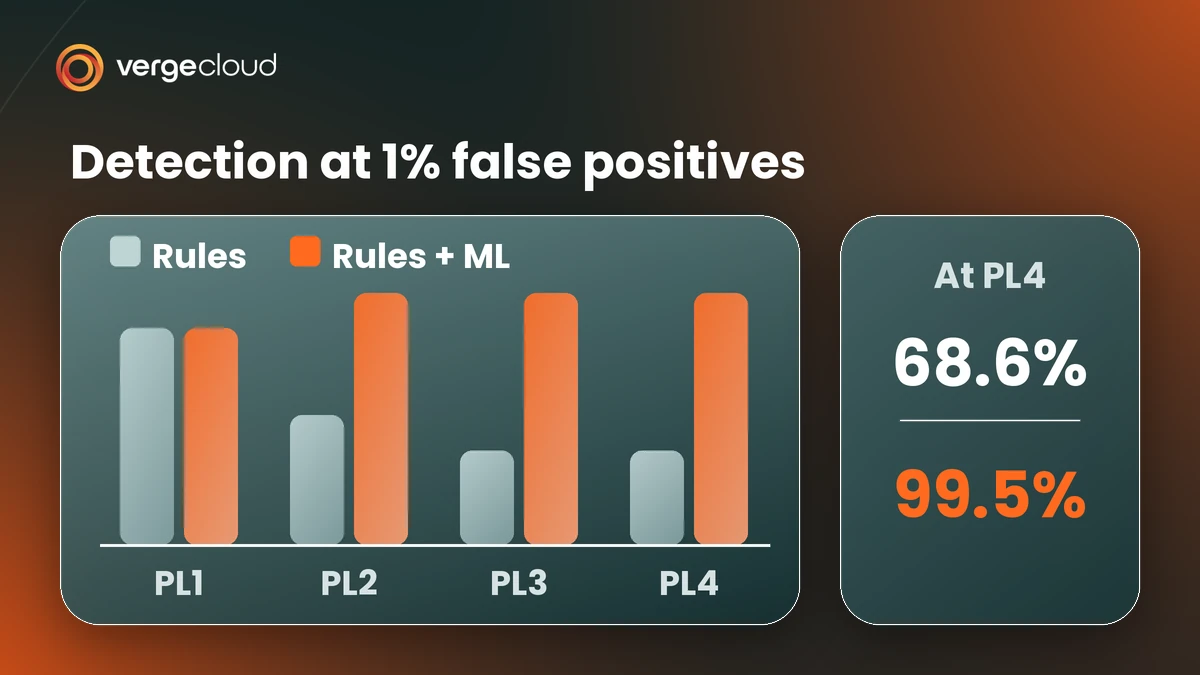
- ML works best on top of signature rules, not instead of them. In the ModSec-Learn study, adding a Random Forest to the OWASP Core Rule Set raised detection at a 1% false positive rate from 68.55% to 99.45% at paranoia level 4.
- Supervised models recognize known attack classes in new disguises, while anomaly detection flags behavior that breaks your own traffic baseline, such as credential stuffing.
- ML WAFs are not evasion-proof. The WAF-A-MoLE research tool bypassed every ML-based WAF it was tested against by mutating payload syntax.
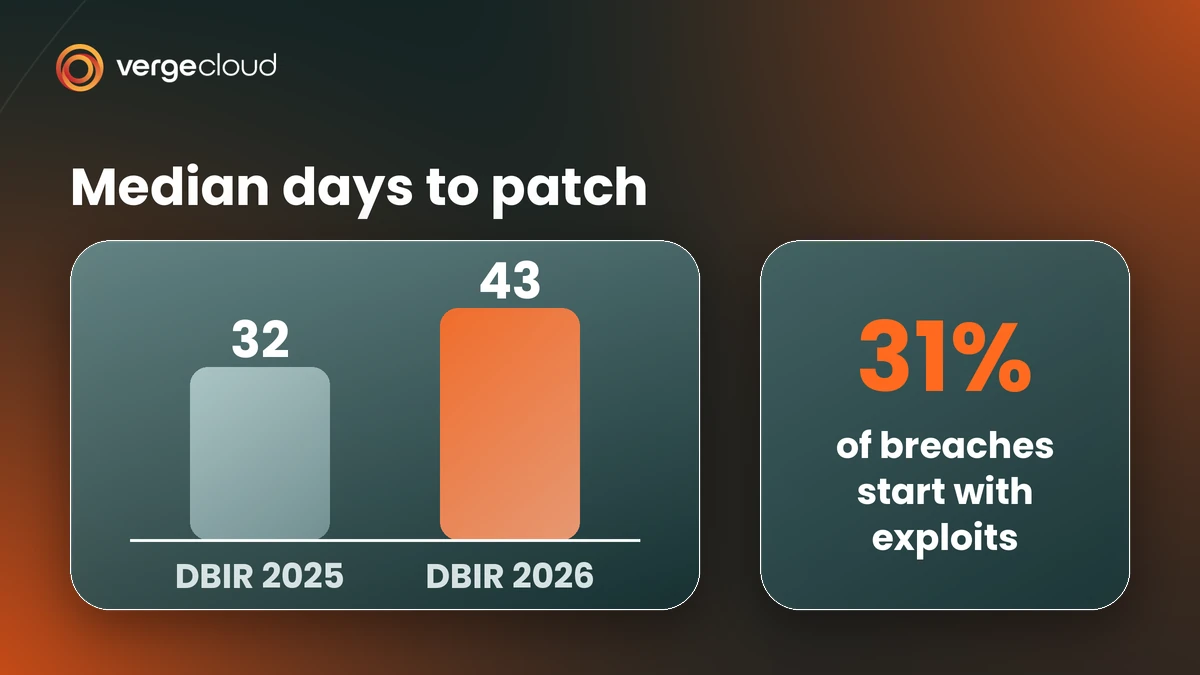
- Vulnerability exploitation now starts 31% of breaches and the median patch time has grown to 43 days, according to Verizon. That gap is the window a WAF has to cover.
- Roll out in monitor mode first, tune thresholds on real traffic, then enforce and retrain after every major release.
- IBM found that organizations using security AI and automation extensively saved an average of $1.9 million per breach and shortened the breach lifecycle by 80 days.
What Is a Machine Learning WAF and How Is It Different?
A machine learning WAF is a web application firewall that uses trained statistical models to decide whether an HTTP request is malicious, based on learned patterns rather than an exact match against a known signature.
A traditional WAF inspects traffic against a library of WAF rules: regular expressions and operators that match known payload shapes such as ‘ OR 1=1 or <script>. If the pattern matches, the rule fires. If an attacker changes the shape enough, it does not.
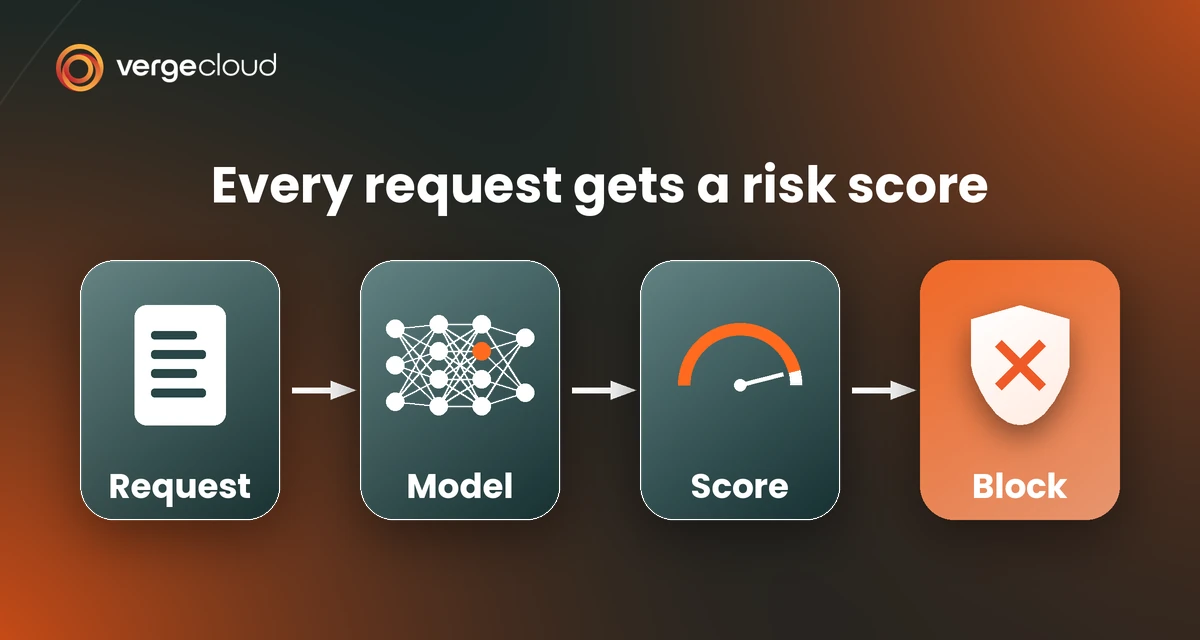
An ML WAF adds a scoring layer. It turns each request into numeric features (token counts, character distributions, parameter lengths, header order, request rate per client) and passes them to a model trained on labeled benign and malicious traffic. The output is a probability or risk score, and the WAF policy decides what to do with it.
Think of how card issuers catch fraud. Your bank does not decline a purchase because the shop sits on a blacklist; it declines it because a 3 a.m. charge in another country looks nothing like your normal spending. An ML WAF applies the same logic to HTTP traffic.
Here is what a machine learning web application firewall typically inspects:
- Payload structure: SQL, shell, and script tokens inside query strings, JSON bodies, headers, and cookies
- Request metadata: header order, user agent consistency, and TLS client fingerprints
- Session behavior: request rate, navigation paths, and login failure ratios per client
- Response signals: error codes and response sizes that suggest a probe is working
The scoring idea is not new. The open-source OWASP Core Rule Set (CRS) already adds points for every matched rule (5 for critical, 4 for error, 3 for warning, 2 for notice) and blocks once the total reaches the recommended inbound threshold of 5, as described in the CRS anomaly scoring documentation. Research projects such as ModSec-Learn replace that fixed arithmetic with a learned model that weights each rule by how predictive it actually is.
“The inspection/detection rule logic is decoupled from the blocking functionality.”
Is an AI WAF the Same as an ML WAF?
In practice, yes. “AI-powered WAF” and “AI WAF” are marketing labels, and in almost every product the AI doing the blocking is machine learning: gradient-boosted trees, random forests, or neural networks for classification, plus clustering or statistical baselines for anomaly detection. Some vendors now add large language models for rule drafting or alert summaries, but the per-request block decision still comes from a smaller, faster model.
What most buyers miss is the follow-up question. When a vendor says “intelligent WAF”, ask which model makes the block decision, what data trained it, and how often it is retrained. The answers tell you far more than the label does.
If signature WAFs have protected applications for two decades, why add a model at all? The answer lies in how fast attackers change their payloads.
Why Do Signature-Based WAFs Fall Behind?
Signature-based WAFs fall behind because they can only block what someone has already described, while attackers mutate payloads faster than rules are written and organizations patch slower than exploits spread.
Verizon’s 19th Data Breach Investigations Report found that 31% of breaches now start with vulnerability exploitation, the first time in the report’s history that exploitation has overtaken stolen credentials as the top entry point. The median time to patch grew to 43 days, up from 32 days in the previous edition, and only 26% of CISA Known Exploited Vulnerabilities were fully remediated.
Two real incidents show the problem clearly:
- Log4Shell (CVE-2021-44228, CVSS 10.0): early WAF rules blocked the literal string ${jndi. Attackers quickly switched to nested lookups such as ${${lower:j}ndi:, which Log4j resolves into the same call but which no longer matches the literal pattern. Check Point reported more than 60 variants of the exploit within 24 hours of disclosure.
- MOVEit Transfer (CVE-2023-34362): the Cl0p group exploited this SQL injection zero-day starting on May 27, four days before Progress Software shipped a patch on May 31, according to the CISA advisory AA23-158A. Emsisoft’s tracking counted more than 2,700 affected organizations and roughly 93.3 million individuals.
Both cases expose the same three structural limits of signatures:
- Rules match syntax, and attackers change syntax. Encoding, inline comments, mixed case, whitespace, and nested functions all break literal matches. Our breakdown of WAF bypass techniques shows how routine these tricks are.
- Protection starts after disclosure. Every new CVE needs someone to write, test, and ship a rule, so coverage begins after the exploit is already public.
- Tighter rules mean more false positives. The OWASP Core Rule Set exposes this trade-off directly through four paranoia levels, where each step up catches more variants and blocks more legitimate traffic.
None of this makes signatures obsolete. Well-maintained custom WAF rule packages remain the fastest way to virtually patch a named CVE like MOVEit. The weakness is the coverage between patches, and that gap keeps widening.
“Attacks always get better; they never get worse.”
So what does a model actually look at when a request arrives, and how does it turn that into a decision?
How Does a Machine Learning WAF Detect Threats?
A machine learning WAF detects threats by normalizing each request, extracting features, scoring them with trained models, combining that score with rule and reputation signals, and acting on the result before the request reaches the origin.
Most production engines follow the same five stages, even when vendors name them differently:
- Parse and normalize. Decode URL, Base64, Unicode, and HTML entity encoding, and flatten JSON and multipart bodies, so obfuscation layers are removed before inspection.
- Extract features. Tokenize parameters (SQL keywords, operators, shell metacharacters), measure length and entropy, and attach behavioral context such as requests per minute from the same client.
- Score with models. A supervised classifier estimates how likely the payload is an attack; an anomaly model estimates how far the request sits from the application’s learned baseline.
- Combine signals. Merge model scores with signature hits, IP reputation, and client fingerprints into one risk score.
- Act and learn. Allow, log, challenge, rate limit, or block, then feed analyst verdicts on false positives and missed attacks back into retraining.
Here is a simplified, illustrative feature record for a single request as it moves through that pipeline. Field names vary by product, but the structure is typical:
Supervised Classification for Known Attack Classes
Supervised models learn from labeled examples of injection attacks, cross-site scripting, path traversal, and clean traffic. Because they learn relationships between tokens rather than exact strings, they treat UnIoN/**/SeLeCt as the same idea as UNION SELECT.
Published baselines show how accurate these classifiers are on known data. In the WAF-A-MoLE study, a token-based Random Forest reached 98.33% accuracy and the character-level neural network WAF-Brain reached 98.27% on the researchers’ SQL injection dataset, before any adversarial mutation was applied. That caveat matters, and the section on failure modes below explains why.
Anomaly Detection and Behavioral Analysis
Anomaly detection learns what normal traffic looks like for your application and flags deviations, even when each individual request is syntactically clean. A behavioral analysis WAF watches patterns such as a login endpoint suddenly receiving bursts of attempts from rotating IP addresses, each trying a different username and password pair.
That is the signature of credential stuffing, and it caused one of the most cited breaches of recent years. Attackers used reused passwords against 23andMe accounts over roughly five months starting in April, and the UK Information Commissioner’s Office later fined the company £2.31 million, noting that data on 155,592 UK residents was exposed.
Behavioral signals work best alongside rate limiting and client identification such as JA3 fingerprinting, which ties requests to a TLS client even when the IP address keeps changing. At higher volumes, the same baseline logic supports DDoS protection against application layer floods that look like ordinary page views.
How much does all of this add on top of rules? Published research puts a number on it.
Machine Learning WAF vs Rule-Based WAF: What the Data Shows
A machine learning WAF layered on a rule-based engine detects far more attacks at the same false positive rate than rules alone, at the cost of lower transparency and the need for good training data.
The clearest public evidence comes from ModSec-Learn, a study by researchers from the University of Cagliari, SAP Security Research, EURECOM, and partner organizations. Instead of summing fixed severity points, they fed individual CRS rule matches into machine learning models and measured SQL injection detection at a 1% false positive rate.
- Rules only: ModSecurity with CRS detected 92.50% of attacks at paranoia level 1, but just 68.55% at paranoia levels 3 and 4, because higher levels add noisy rules that push legitimate traffic over the threshold.
- Rules plus ML: with a Random Forest on top, detection reached 99.41% at paranoia level 2 and 99.45% at levels 3 and 4.
- Dead weight exposed: the model gave zero weight to 18 of the 60 SQL injection rules, so more than 30% of them contributed nothing.
That last finding is the one most people overlook. Besides raising detection, the model showed that almost a third of carefully written rules added noise and caught nothing.
| Aspect | Rule-based WAF | Machine learning WAF |
|---|---|---|
| Detection method | Pattern and regex matching against signatures | Statistical models scoring learned features |
| New variants and zero-days | Covered only after a rule is written | Can flag unseen variants that resemble known classes or break the baseline |
| False positive control | Manual tuning and rule exclusions | Threshold tuning on a score; depends on clean training data |
| Explainability | Exact rule ID and matched string | Feature contributions; quality varies by vendor |
| Time to value | Works on day one | Needs a learning period on your own traffic |
| Main evasion risk | Encoding and obfuscation tricks | Adversarial mutation guided by model output |
| Best use | Virtual patches for named CVEs and compliance baselines | Obfuscated payloads, bots, abuse, and API anomalies |
You might be thinking the obvious next step is to retire your rule set. It is not. ModSec-Learn kept every CRS rule as a model input, and the gains came from weighting those rules better. The same layering principle applies across the stack, which is why it helps to understand how a WAF differs from an IPS before deciding which layer owns which decision.
Which leads to the part vendor datasheets rarely mention: models can be fooled as well.
Where Machine Learning WAFs Still Fail
Machine learning WAFs still fail against adversarial payloads built to exploit the model, against drift when your application changes, and against business logic attacks that look exactly like normal traffic.
Yes, ML catches obfuscation that signatures miss. But an attacker who can observe how your WAF responds can run the same optimization in reverse, mutating a payload step by step until the score drops below the block threshold.
- WAF-A-MoLE, from a University of Genoa-led team presented at ACM SAC, uses mutation operators that change SQL syntax without changing its meaning. It evaded every ML-based WAF in the test set, including WAF-Brain, token-based classifiers, and the graph-based SQLiGoT, although SQLiGoT held up longest.
- AdvSQLi tested seven WAF-as-a-service products from mainstream vendors and found all seven vulnerable. Against state-of-the-art ML-based SQL injection detectors trained on public datasets, it reached a 100% attack success rate.
NIST treats these risks as a formal category. Its Adversarial Machine Learning taxonomy (NIST AI 100-2 E2025) classifies evasion and data poisoning as distinct attack types with their own mitigations, which is a useful checklist when you question a vendor.
False Positives and Explainability
Every blocked legitimate request becomes a support ticket or a lost sale, and a black-box score is harder to debug than a rule ID. WAF false positives are a common reason teams hesitate to move a WAF from log-only mode to blocking, and an unexplained model makes that hesitation stronger. Insist on per-decision explanations and per-endpoint thresholds.
Model Drift and Data Poisoning
When you ship a new API version, the baseline shifts. A model trained on last quarter’s traffic may flag the new endpoint as anomalous or, worse, learn attack traffic as normal if poisoned samples enter the training set. Scheduled retraining with reviewed labels is the fix, not a one-time setup.
Logic flaws are the final blind spot. Broken Access Control sits at A01 in the OWASP Top 10:2025, and a request that reads another user’s invoice by changing an ID is syntactically perfect. Payload models will not flag it; only behavioral signals such as unusual enumeration rates might.
These weak spots are exactly what a vendor evaluation should probe.
How to Evaluate an AI-Powered WAF Before You Buy
Evaluate an AI-powered WAF by testing it on your own traffic and your own attack samples, measuring detection at a fixed false positive rate, and confirming that every block decision can be explained.
Start by mapping your attack surface so the proof of concept covers every public hostname and API, not just the marketing site. Then score each candidate on these criteria:
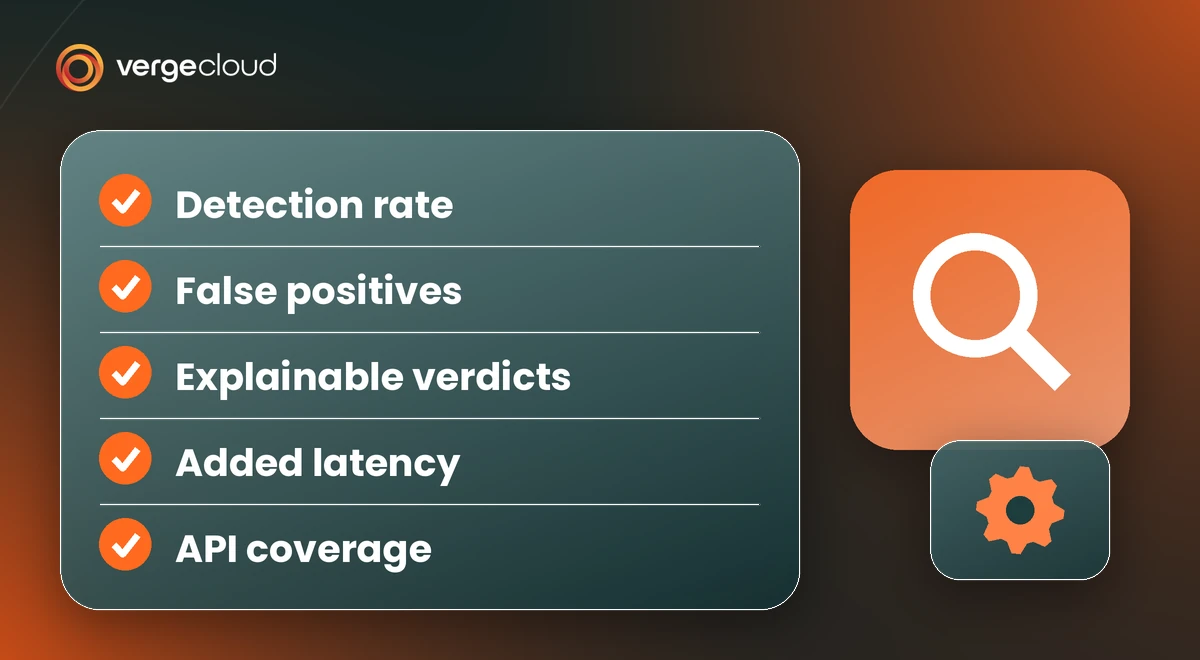
- Detection at a fixed false positive rate: ask for the true positive rate at 1% false positives or lower, the same metric ModSec-Learn used. Raw accuracy hides class imbalance.
- Resistance to evasion: ask whether the vendor tests models against mutation tools and how often they retrain.
- Explainable verdicts: every block should show the score, the top features, and any matched rule IDs.
- Added latency: measure p95 and p99 latency under your own peak load rather than accepting a vendor benchmark.
- Protocol coverage: JSON, GraphQL, gRPC, WebSocket, and file uploads should be parsed and inspected, not passed through.
- Data handling: confirm where request samples are stored and whether your traffic trains a shared model.
Compliance adds a hard requirement for many buyers. PCI DSS v4.0.1 requirement 6.4.2 calls for an automated technical solution in front of public-facing web applications that continually detects and prevents web-based attacks, and it is now mandatory rather than a best practice. A WAF running only in log mode does not meet the “prevents” part, so confirm the blocking configuration during the trial.
Map your test cases to the OWASP Top 10:2025 as well. Expect ML to help most with Injection (A05) and automated abuse, and much less with Broken Access Control (A01), which needs authorization fixes in the application itself.
You might be thinking a proof of concept is too much effort for a WAF purchase. Two weeks on mirrored traffic costs far less than discovering the false positive behavior after enforcement is switched on.
Once a product passes that test, the rollout plan decides whether it stays switched on.
Deploying a Machine Learning WAF Without Breaking Production
Deploy a machine learning WAF in four phases (monitor, tune, enforce, retrain) and keep signature rules active the entire time.
- Monitor. Route traffic through the WAF in log-only mode, the same idea as ModSecurity’s SecRuleEngine DetectionOnly setting, and let the model learn a baseline across at least one full business cycle, including peak days.
- Tune. Review the highest-scoring legitimate requests, set per-endpoint thresholds, and add exclusions for known-safe patterns such as rich-text editors and search fields.
- Enforce. Switch high-confidence verdicts to block, send mid-range scores to a challenge or rate limit, and watch error rates on critical user journeys.
- Retrain. Feed confirmed false positives and missed attacks back into training, and retrain after every major release.
Architecture matters as much as sequence. Most ML WAFs run as a reverse proxy WAF, so TLS terminates at the WAF and the model inspects decrypted payloads. Running that inspection at the edge security layer also stops attacks before they consume origin CPU and database connections.
The MOVEit timeline shows why the rule path has to stay open. Four days passed between the first exploitation and the vendor patch. Once indicators were public, a targeted virtual patch could be deployed within hours, while retraining a model on fresh samples takes far longer.
Protecting APIs and AI Applications
Behavioral models matter most on APIs, because API abuse often uses perfectly valid syntax: object ID enumeration, scraping, and oversized data requests. Broken Object Level Authorization tops the OWASP API Security Top 10 as API1, and it shows up as an unusual access pattern rather than a malicious string. LLM-backed features raise the same issue, and AI application security means inspecting prompts and usage rates alongside classic payloads.
With the rollout planned, the last question is whether the investment pays back.
Is a Machine Learning WAF Worth the Investment?
For most organizations running public web applications or APIs, yes. The cost of an ML WAF is small next to the breach costs it helps prevent, provided it is layered with rules and tuned on real traffic.
IBM’s Cost of a Data Breach Report puts the global average breach at $4.44 million. Organizations that used AI and automation extensively across security operations saved an average of $1.9 million per breach and cut the breach lifecycle by 80 days. That figure covers security AI broadly, not WAFs alone, so treat it as directional rather than a WAF-specific return.
The right setup depends on what you run. The table below matches common scenarios to the approach that fits, and it pairs well with a broader plan for preventing data breaches:
| Scenario | Best fit | Why |
|---|---|---|
| Brochure site with a few forms | Managed rule set | Low attack diversity, so an ML baseline adds little |
| E-commerce or payments in PCI scope | Rules plus ML in blocking mode | Requirement 6.4.2 and high automated attack volume |
| Public APIs and mobile backends | Rules plus ML with behavioral models | Abuse often uses valid syntax |
| Fast-changing app with weekly releases | Rules plus ML with scheduled retraining | Model drift risk is highest |
| High-value targets in finance, healthcare, or SaaS | Rules plus ML plus adversarial testing | Attackers will actively probe the model |
Final Thought on Machine Learning WAF
A machine learning WAF works best as the layer that covers what rules cannot see. The evidence points the same way from both directions: models sharply raised detection when added to the OWASP Core Rule Set, and adversarial research showed that models on their own can be steered around. The strongest protection uses both, with each covering the other’s blind spot.
If you are choosing or tuning one now, judge it on your own traffic: detection at a fixed false positive rate, explainable decisions, and a retraining process you can inspect. Start in monitor mode, enforce gradually, and keep a fast path for signature patches. That balance between detection, usability, and control is what keeps applications protected without getting in the way of the people who use them.
Common Questions About Machine Learning WAF
Does a machine learning WAF slow down my website?
It adds some processing to each request, but production models are usually lightweight tree ensembles or compact neural networks built for inline scoring. The real impact depends on the vendor and your traffic, so measure p95 and p99 latency during a trial. Edge deployment and caching often offset the added inspection time.
How long does an ML WAF need to learn my traffic?
Supervised attack classifiers ship pretrained, so they detect common injection and scripting patterns from the first request. Anomaly baselines need to see your normal traffic first, which means at least one full weekly cycle and longer for businesses with seasonal peaks.
Can an ML WAF inspect encrypted HTTPS traffic?
Yes, when it terminates TLS, which is standard for cloud and reverse proxy WAFs. Without decryption it can still use metadata such as TLS client fingerprints, request timing, and volume, but it cannot score the payload itself.
Can I add machine learning to an existing ModSecurity and CRS setup?
Yes. ModSec-Learn published open-source code that uses CRS rule matches as model inputs, and many commercial WAFs run ML scoring alongside CRS-compatible rules. Keep your existing exclusions and tuning, since the model builds on top of them.
