
Second-Order SQL Injection is an attack in which a malicious value is safely stored during one request, then executed later when another part of the application retrieves that value and incorporates it into a SQL query without escaping. The vulnerability does not trigger at the initial entry, which allows it to bypass traditional checks that detect classic injection. The payload remains in the database as a dormant threat and executes when reused.
This guide explains how SQL injection stored in database scenarios work, how Second-Order SQL Injection differs from first-order attacks, provides a Second-order SQL injection example from real-world code, and details evidence-backed SQL injection prevention and detection methods. If you have ever questioned why an input cleared by your scanner still resulted in a breach, Second-Order SQLi is often the reason, occurring in a later application request.
Key Takeaways
- Second-Order SQL Injection stores attacker input that appears harmless, then triggers when the application reuses that stored value in a new SQL query.
- The injection point and execution point occur in separate requests, so standard SQL injection testing tools almost always miss this attack.
- This attack is also known as stored SQL injection or delayed SQL injection because the payload resides in the database until it is executed.
- Escaping input only when storing does not prevent the risk, since the value is trusted and reused later without additional validation.
- Parameterized queries are the most reliable defense against Second-Order SQL Injection because they keep code and data separate in every query, even when reusing stored data.
- Effective SQL injection detection requires data-flow tracing and second-order aware tools, not just single-request SQL injection testing.
What Is Second-Order SQL Injection?
Second-Order SQL Injection is a stored injection flaw: attacker input is harmless when first saved, but when it is later concatenated into a SQL query, it executes as code. The database serves as the delivery mechanism, holding the payload from submission until execution.
The risk is misplaced trust. Developers familiar with SQL injection often escape input when it first arrives, then assume the same value is clean when retrieved from storage. While a robust web application firewall can filter obvious payloads at the perimeter, true SQL injection prevention requires treating stored data with the same caution as new requests.
The critical point: the value does not change. It is malicious when stored and remains malicious when retrieved. No sanitization occurs in between, because developers often do not expect it to be necessary.
With the definition set, the next question is mechanical: what exactly happens between storage and execution?
How Second-Order SQL Injection Works
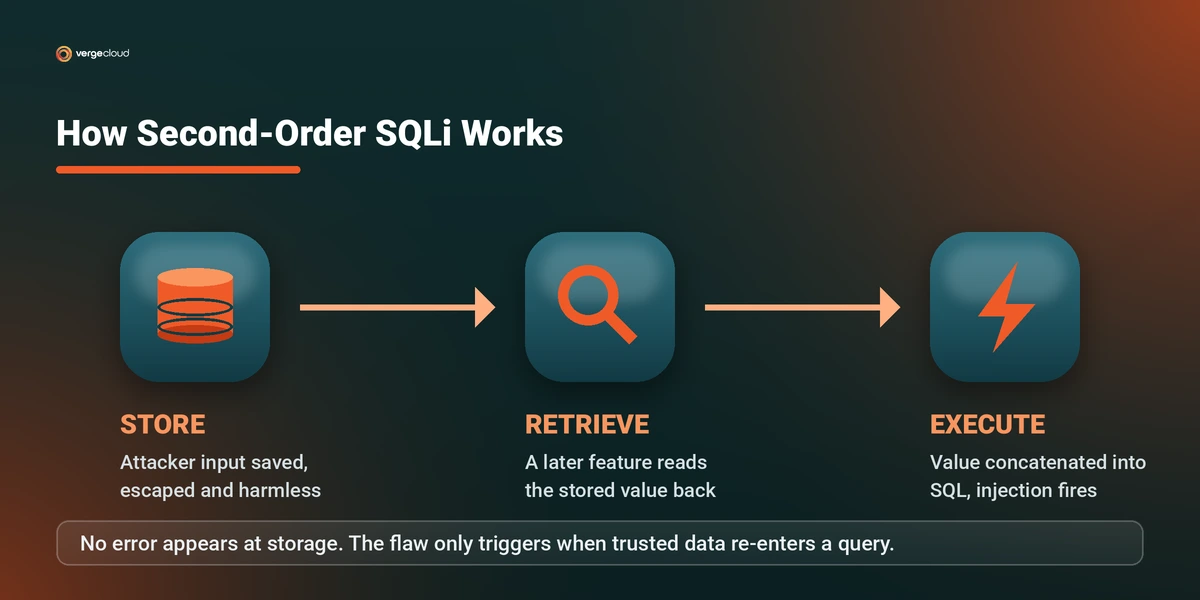
Second-Order SQLi involves three steps: storing attacker input, retrieving it later, and executing it. The application accepts input and saves it to the database, then reads it back in a later operation and uses it to build a new query without parameterization.
This is the same root cause behind every injection attack fundamentals case: user data crosses the line from value to executable syntax. Second-order injection just adds a time gap, which is what makes it slippery.
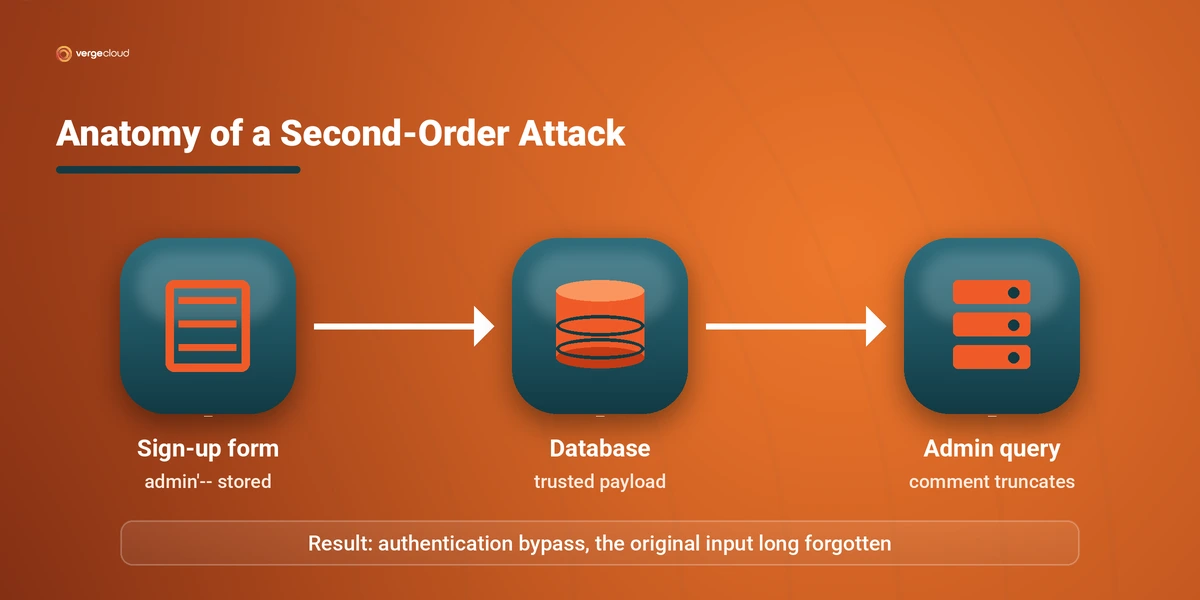
A classic Second-Order SQL injection example is the username admin’– . When stored as a string, it seems harmless, but if reused in a lookup query, the trailing comment truncates the rest of the SQL, causing the check to fail.
It is similar to a sleeper agent who passes security with a clean passport, then acts after entering the building. The security check was real, but it happened at the wrong stage.
// Stored safely at registration
// (escaped, no error here)

username = "admin'-- "

// Reused later without parameters,
// injection fires

"SELECT * FROM users WHERE username = '" + storedName + "'"
You might assume that escaping input would prevent this attack. It does not, because the escaped value is often restored to its original form when saved, and the second query does not escape it again. This gap enables the attack.
Second-Order vs First-Order SQL Injection
The difference is timing and location: first-order injection fires in the same request, second-order fires on a later one. That single change defeats most single-request testing.
First-order injection is loud. It shows up as error-based SQL injection when the database leaks messages, or as blind SQL injection when it does not, but either way the tester sees a signal on the same request. Second-order injection returns a clean response at the injection point, so that signal never appears where you are looking.
| Aspect | First-order SQL injection | Second-order SQL injection |
|---|---|---|
| Injection point | Same request that runs the query | A storage request, separate from execution |
| When it fires | Immediately | Later, when the stored value is reused |
| Scanner visibility | High, single-request payloads catch it | Low, needs data-flow tracing |
| Primary fix | Parameterized queries | Parameterized queries on reuse too |
“For this reason, second-order SQL injection is also known as stored SQL injection.”
Yes, first-order testing is faster and cheaper. But relying on it alone leaves the stored variant completely uncovered, and that is the gap real attackers walk through.
A Real Second-Order SQL Injection Example
A documented case is CVE-2018-6376, a second-order SQL injection in Joomla before version 3.8.4. Sonar (then RIPS Technologies) reported that a low-privilege Manager account could store a crafted value that a later query used unsafely, escalating to full administrator access.
The pattern matches the theory exactly. The malicious value entered through one backend function was stored, then read back and concatenated into SQL in a different code path because a variable lacked proper type casting. The National Vulnerability Database scored it 9.8, critical.
“Parameterized queries therefore better embody a secure by design approach.”
The stakes are not academic. CISA and the FBI issued a Secure by Design alert on eliminating SQL injection after the Clop ransomware group exploited an SQLi flaw in the MOVEit file transfer tool, a campaign that reached thousands of organizations and tens of millions of downstream people.
The lesson from these cases is consistent: the storage step looked responsible, and the failure lived in the reuse. Which raises the practical problem of finding that reuse before an attacker does.
How to Detect Second-Order SQLi
Detection means tracing data, not just firing payloads. Because the injection point returns a clean response, you find these flaws by following a stored value from where it enters to every place it is later read.
- Map inputs that get stored: usernames, profile fields, filenames, sorting preferences, and workflow state.
- Find every downstream feature that reads those fields back, especially admin panels, reports, exports, and background jobs.
- Submit a marker payload at storage, then exercise each downstream feature and watch for query errors or behavior changes.
- Confirm with a tool that supports the two-request flow before writing it up.
sqlmap automates the second request directly. You point it at the request that stores the payload, then tell it where the result is rendered.
Well-tuned WAF rules also help on the monitoring by flagging suspicious stored strings, such as stray single quotes or SQL comment markers, that appear later in query logs. These alerts alone do not prove exploitation, but they help reviewers focus on relevant fields for SQL injection detection.
# Inject on one request, read the result on another

sqlmap -r register.txt -p username \
  --second-order http://target.example/profile
Once you can see the reuse points, closing them is the straightforward part, provided you use the right control.
How to Prevent Second-Order SQL Injection
Parameterized queries stop second-order injection because they separate code from data on every query, including queries built from stored values. The database receives the SQL structure first, so a stored string can only ever be a value, never new syntax.
Escaping is the control that fails here. It is brittle, easy to apply inconsistently, and it does not survive a round trip through storage. Parameterization does, which is why national guidance keeps pointing to it over input sanitization.
Layer these controls so no single failure is fatal:
- Parameterized queries everywhere: bind stored values on reuse, not just fresh request parameters.
- Validate on reuse: re-check format and type each time data leaves the database, using allowlists for critical fields.
- Filter at the edge with an OWASP Core Rule Set ruleset that blocks common SQLi signatures before they reach your application.
- Slow down automated probing with rate limiting so mass injection attempts are throttled.
- Add network enforcement through a firewall layer that controls traffic reaching the database tier.
- Least-privilege database roles: cap what a compromised query can read or change.
The edge controls buy time and cut noise, but they do not repair vulnerable query logic. The application fix and the perimeter defense work together, and neither replaces the other.
Final Thought on Second-Order SQL Injection
Second-order SQL injection endures because it exploits a reasonable assumption: that data already inside your database is safe. It is not. The value an attacker stored is the value your next query runs, and the gap between those two moments is exactly where the risk hides.
The durable fix is not a smarter filter but a structural one. Parameterize every query, revalidate data on the way out of storage, and give database accounts only the access they truly need. Layer perimeter controls on top for defense in depth, and trace stored values through your codebase so you know where they resurface. Get those habits right and the entire class of stored injection stops being a surprise waiting one request downstream.
Common Questions About Second-Order SQL Injection
Is second-order SQL injection the same as stored SQL injection?
Yes. The terms describe the same flaw. The payload is stored on one request and executed later when the application reuses it, which is also why some sources call it delayed SQL injection.
Why do scanners miss second-order SQLi?
Most automated scanners test one request at a time and check the immediate response. Second-order injection returns a clean response at the storage step, so the scanner sees nothing and moves on.
Does escaping input prevent it?
No. Escaping protects the storage step, but the stored value is decoded back and often reused in a later query without escaping. Parameterized queries on that reuse are what actually stop it.
Can a WAF alone block second-order SQL injection?
A WAF reduces exposure by filtering known payloads and flagging suspicious stored strings, but it cannot fix unsafe query construction. Application-level parameterization remains the core control.
